
The Honda Heated Steering Wheel Retrofit Guide
How a heated steering wheel retrofit works on a Honda Civic, CR-V or Accord: what the upgrade adds, fitment checks and how to test the heater afterwards.
Read More →Guide · 10/19/2026
A modified Honda does not lose its warranty as a whole. Here is how the causation test works, what a dealer can still ask, and how to keep a claim on the record.
A service writer says the wheel change may affect your coverage, and the conversation stops being about the car. What follows is what the federal warranty law actually says, and how a Honda owner can use it without turning the visit into an argument.
The short version is that a modification does not void a warranty on its own. Coverage depends on cause, and cause is a question of evidence rather than opinion.
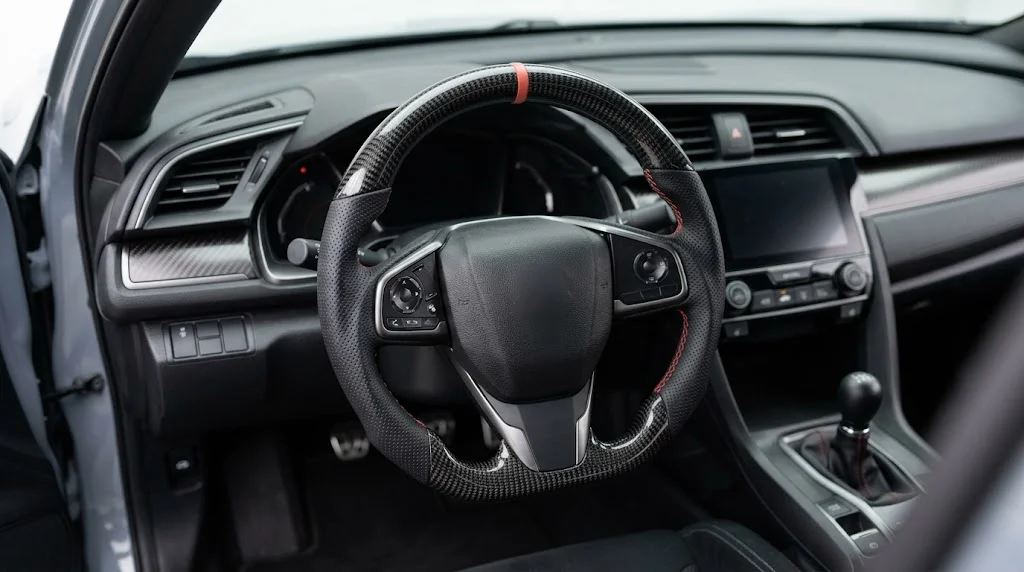
The phrase usually runs along the lines of "we cannot cover that, the steering wheel is not stock". It arrives early, before anyone has looked at the failed part. Ask ten owners and most will describe a Honda steering wheel warranty refusal that landed before the inspection.
Two different claims get mixed together in that moment. One is about the whole vehicle warranty, and the other is about a specific repair job. The law treats them differently.
A blanket cancellation of the whole warranty for a bolt-on change is the version that fails. A refusal to cover one repair, where the change caused it, is the version that can stand.
The Magnuson-Moss Warranty Act sets federal minimum standards for written warranties on consumer products, and it lives in 15 U.S.C. 2304. The section sets out what a warrantor must do, and what it may not do, when it offers a written warranty.
One rule concerns parts. A warrantor generally may not condition coverage on the use of a branded part or service unless that item is supplied free. An owner who fits a custom wheel from another supplier is inside that protection.
The related interpretations sit in 16 CFR Part 700. They expand on how the Act applies, and they are the reference a service manager can check without leaving the desk.
None of this makes a modification risk-free. It makes the question specific: did the changed part cause this failure?
A steering wheel is a control surface on top of a column. It is not part of the engine, the gearbox or the emissions system.
Failures nowhere near the wheel are hard to link back to it. A wheel bearing noise or a failing fuel pump has no path to a rim.
Where the failure sits at the column, the argument gets real. A clock spring that fails after a wheel swap is the kind of claim a dealer can reasonably examine. So is a button pod that stops working.
An aftermarket steering wheel does not automatically void a vehicle warranty under U.S. federal warranty law, but warranty coverage can still depend on whether the modification caused the specific failure being claimed.
The dealer or the manufacturer has to connect the modification to the failure. An opinion is not proof, and a service writer's suspicion is not a finding.
That is why the paperwork matters more than the argument. A repair order that states "non-stock steering wheel fitted" and stops there has not established anything.
An owner can ask for the diagnosis in writing. Once the fault is described, the question of cause becomes something both sides can inspect.
A dealer can ask to see the car, and can inspect the parts involved. It is ordinary practice, and reasonable.
A dealer can also decline a repair it believes a modification caused. The refusal should be tied to a described failure, not to the existence of a part.
A dealer can also refuse to return a car it considers unsafe. The refusal is a safety decision rather than a warranty one, and it stands on its own.
Airbag recalls run on their own track. A recall applies to the vehicle by VIN, and a changed steering wheel does not remove the car from a campaign.
Honda has issued large airbag inflator recalls over the years, and those campaigns are handled by the dealer regardless of trim or accessories. A recall notice is about the vehicle, not about the wheel bolted to it.
A separate point applies to the airbag itself. A cover shaped for the original module is part of the safety system, and fitting work should follow the workshop manual rather than a video.
A certified pre-owned Honda comes with its own limited warranty, and those terms are written by the program rather than by the federal statute alone.
Read the CPO booklet before a wheel goes on. Some programs require the car to remain in factory specification. A custom rim can then fall foul of the program rather than of the warranty.
An extended service contract is a third category. It is a contract, not a warranty under federal law, and its terms decide what it covers. State law may add protection, and the contract itself is the place to look first.
Five items turn an opinion into a file, and a Honda steering wheel warranty claim is decided on paper as much as on the lift. Keep them together from the day the wheel is fitted.
A folder of these costs nothing to keep and changes the tone of the conversation. An owner who can produce a date and a diagnosis is harder to brush aside.
Ask for the denial in writing first. A written statement forces the reasoning into the open, and it is the document any later step relies on.
Second, request a description of how the modification caused the failure. A vague answer is useful in itself, because it shows the link has not been established.
Third, raise it with Honda's customer service line rather than the dealership alone. A regional case number moves the question out of one service bay.
Fourth, look at your state's consumer protection office. Warranty rights are enforced under federal and state law together, and a state office can explain the local route.
The wording matters less than the questions. Put three to the writer. Which part failed, how did the wheel cause it, and is the denial for this repair or for the whole warranty?
Those three answers separate a narrow refusal from a blanket one. The first can be legitimate; the second is where the federal standard applies.
Stay with the repair order. A conversation is hard to rely on later, and a note on the order is not.
A Honda steering wheel warranty question often starts with a wheel ordered in a hurry. The fitment check therefore comes before the legal one.
Send the VIN as well. It tells us which airbag and which button pod the car left the factory with, and that decides the frame. A wheel that fits the column and not the pod is the most common return we see.
Reusing the original module, the loom and the vehicle specific parts is the case where no further coding may be needed. The car keeps talking to the parts it already knows.
A car that gains a function it never had may need the control unit told what is present. Coding is possible in that case rather than certain, and a scan tool report is worth keeping either way.
Three faults come up most often after a wheel change. A button pod from another trim connects differently. A heated rim brings a connector the plain rim lacks, and a disturbed clock spring can log a fault.
The fourth is cosmetic and still annoying. A cover shaped for a different airbag sits proud of the spokes, which shows in photographs long after the sale.
Each of these is caught by the rear photograph and the VIN. None of them needs a legal argument, which is the point of doing the check first.
No, not on its own. Coverage can be refused for a specific failure that the modification caused, which is a narrower outcome than a voided warranty.
A dealer can decline a repair it believes the modification caused. It can also refuse to release a car it considers unsafe, which is a separate decision.
Then the link is hard to argue. Request the diagnosis in writing, and the reasoning that connects the two.
Yes. Recalls are tied to the VIN, and an airbag campaign is handled by the dealer whatever wheel is fitted.
It is worth a written request. A Honda steering wheel warranty denial without a described cause is the case where the federal standard gives an owner something to work with.
They will where the original pod is reused. A pod from another trim may need coding, which is why the rear photograph matters.
Ten to fifteen working days in production, then fifteen to twenty days in transit. The full window is twenty-five to thirty-five days.
Every Honda wheel we build is made for one car, after the order arrives. Nothing is pulled from a shelf, and no pattern is cut until the airbag and the pod have been checked against your VIN.
Thirteen or more years of design, engineering and production sit behind the frames we hold, from Accord columns to Civic Type R pods. Covering, stitch and rim shape stay your decisions, and each is matched to the car before work starts.
Orders ship tracked worldwide with a three-year warranty on our own build and thirty days for a return through an RMA request. If a dealer asks who made the wheel, the answer comes with a build sheet and a date.
Three pages here carry the same thread further. The installation and airbag guide covers the battery, the module and the torque step. The flat-bottom and round comparison deals with shape. The Civic Type R guide sets out the trims by year.
The range sits in the shop. Honda pages worth opening are the brand listing, the Civic page, the Accord page and the CR-V page.
Before the next service visit, put the build sheet, the photographs and the VIN in one folder. A Honda steering wheel warranty conversation is shorter when the file is already open.
Two builds in the catalogue suit these cars. The carbon fiber wheel listed for the Accord keeps a factory shape with a thumb grip patch. The Civic wheel for the Si, EX and LX covers the tenth-generation cars, and both can be built to reuse your original airbag and pod.
Background reading sits in the installation guide, the FAQ and the about page. Fitment and delivery questions can go to the contact page or the inquiry form. The shipping policy lists the transit window, and the return policy covers a return.
How a heated steering wheel retrofit works on a Honda Civic, CR-V or Accord: what the upgrade adds, fitment checks and how to test the heater afterwards.
Read More →How a flat bottom and a round rim differ on a Honda: which shape suits a Civic Type R, a daily Civic, an Accord or a CR-V, and what changes at the wheel.
Read More →How to clean carbon fiber and Alcantara on a Honda steering wheel: a ten minute routine, the cloths to use, and the products that damage both surfaces.
Read More →