
The Honda Steering Wheel Warranty and Magnuson-Moss Guide
A modified Honda does not lose its warranty as a whole. Here is how the causation test works, what a dealer can still ask, and how to keep a claim on the record.
Read More →Guide · 9/30/2026
How to specify a custom steering wheel for a Honda Civic Type R FK8 or FL5: fitment checks, the factory functions you can keep, materials and installation.
The Civic Type R exists for one thing: going quickly in a front-wheel-drive car that still works on a Monday. Drivers commute in it, then take it to a track day and drive home again. The rim takes the worst of both. Sweat, sun and constant hand movement polish the surface flat, and a flat surface stops telling you what the front tyres are up to. A custom Honda Civic Type R steering wheel brings that back.
This page covers two Type R generations, alongside the tenth-generation Civic and the Accord. Their wheels are not shared, so locate your row and then let us verify the rest.
| Chassis | Model and typical years | What usually matters |
|---|---|---|
| FK8 | Civic Type R, 2017 to 2021 | Manual only; Honda Sensing button set varies by market |
| FL5 | Civic Type R, 2023 onwards | Newest generation, different centre and spoke layout |
| FC / FK7 | Civic, tenth generation | Shared wheel families in several trim levels |
| Accord | Separate model line | Automatic cars use a different wheel family with paddles |
Matching a Honda Civic Type R steering wheel to the right generation is the first job. Market specification matters too, because sensing hardware differs between regions.
A track day is the hardest thing you can do to a rim. For a car that does both, a Honda Civic Type R steering wheel is the part worth renewing. Heat from the cabin, moisture from your hands and dozens of grip changes wear leather down far quicker than road miles. Once the shine appears, the wheel stops feeding anything back, and in this car that is a genuine loss.
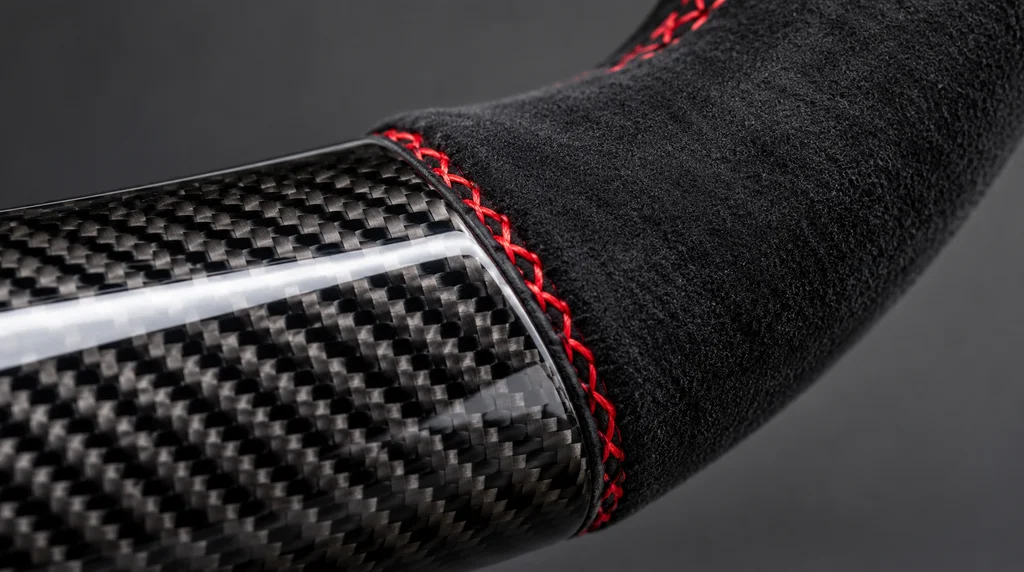
The material decision follows from that. It decides how a Honda Civic Type R steering wheel feels in your hands. The suede keeps its bite when everything is hot, which is why Honda fits it to the Type R in the first place. Gloss carbon looks sharp on the upper and lower sections, where palms never rest. Vivid red stitching is the detail that ties the wheel to the rest of the car.
Four finishes cover almost every Type R order we take. Each Honda Civic Type R steering wheel begins with how the car is used. The grid below compares them for road use and track work.
Suede returns the most grip and throws back the least glare. It soaks up oils from bare hands, so a soft brush every few weeks keeps the nap alive. Drivers who use the car hard regard that as part of the ritual.
A gloss carbon insert gives the sharpest visual change on offer. The weave catches light along the top and bottom of the rim, and the clear coat keeps it crisp. Dust and water marks show easily, so it rewards regular cleaning.
Perforations let air reach the palms, which keeps the grip predictable on a warm day. It wipes down quickly after a wet morning and handles family duty without complaint.
Smooth leather is the closest match to the standard Honda finish, so the wheel never looks added. It is also the simplest surface to keep clean and the softest over a long motorway run.
| Finish | How it feels | Care | Suits |
|---|---|---|---|
| Suede Alcantara | Maximum grip | Brush regularly | Track days, hard road use |
| Gloss carbon | Crisp and reflective | Wash often; shows dust | Visual impact, covered cars |
| Perforated leather | Cool and dry | Balm twice yearly | Warm climates, commuting |
| Smooth leather | Soft and familiar | Damp cloth | Long journeys, factory look |
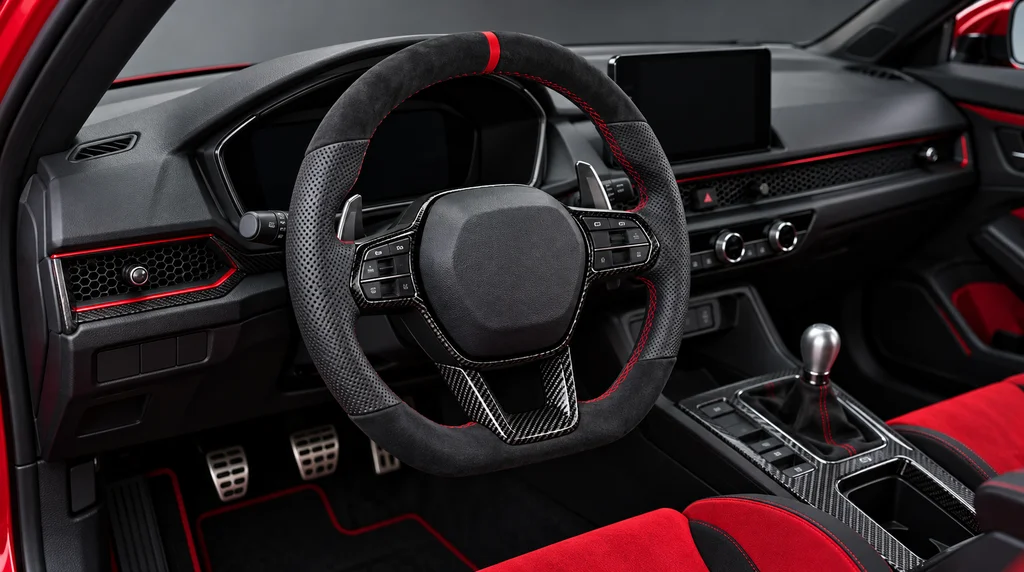
Gather five things and the answer is usually obvious. You need the chassis number and the full option list. You also need a daylight frame of the wheel face. Add a frame of its back with the airbag out, and the market it was sold in.
That bundle reveals the spoke profile, the button cluster and the connector type. Honda Sensing hardware changed across markets and model years, so the option list carries real weight. We cut nothing until the match is confirmed, and we will ask for a sharper photograph rather than guess.
Removing a worn rim should not remove a working switch. Our builds reuse the factory frame and loom.
| Function | Typical outcome |
|---|---|
| Airbag | Original module normally reused; cover built to suit it |
| Multifunction buttons | Retained when the original button frame is reused |
| Honda Sensing controls | Depends on the hands-on detection fitted to the original wheel |
| Drive mode buttons | Retained where the original frame carries them |
| Horn | Retained through the original airbag module |
The heating mat and the hands-on sensor each need a photograph of their own. Neither can be judged from the front of the wheel.
Your own wheel can be rebuilt, which leaves every electronic part exactly as Honda fitted it. The frame, the loom and the switches all stay standard, and that is the safer path on a newer FL5.
A newly made core is the other path, and it keeps your factory wheel in the garage. It suits a financed car that must return to standard, or an owner who wants the original kept for a future sale. On an FK8, used wheels are common enough that a donor is usually cheaper.
Pairing suede with a carbon insert is the usual request here. Alcantara covers the grips where your hands work, and gloss carbon runs along the upper and lower rim. Vivid red stitching then echoes the badges and the seat belts without becoming loud.
A round rim keeps the wheel even through every steering input, which suits a car used mainly for commuting. A flat lower edge gives extra clearance for a tall driver and matches the motorsport look. Neither shape changes the steering itself, so this is a comfort and appearance choice.
Airbag work belongs with a trained pair of hands. Kill the battery and allow the car to go to sleep before anything is loosened. Follow Honda's published sequence for your chassis rather than a general guide from the internet. Lay the module down on something soft. The centre nut is torqued to the manual figure, and nothing else should be used for it.
Afterwards, a short drive confirms the wheel is centred. Run through the switches, the horn, and any paddles. Leave a warning lamp lit and the car should be scanned before it is driven again.
Modification and warranty are often confused. An aftermarket steering wheel does not automatically void a vehicle warranty under U.S. federal warranty law, but warranty coverage can still depend on whether the modification caused the specific failure being claimed.
Coding questions arrive before almost anything else. Reusing the factory module, wiring and vehicle-specific components may remove the need for it entirely. A module from a different generation is another situation, and the control unit may need to be told what is fitted.
That varies by car, so we describe coding as a possible step rather than a promise. Send the chassis number and images of both electronics sets, and we will say whether a dealer trip looks likely.
Failures on these cars cluster around a few causes. The most common is a wheel from a neighbouring generation that does not share the button frame, which the cluster soon reveals. A heated wheel on a car that never had one leaves a plug and a switch with nothing to do. The reverse happens too. Driver assistance depends on the sensing hardware inside the factory rim, so substituting it can trigger messages. A cover shaped for an airbag from another trim is the quiet cosmetic failure. Five checks clear them all.
They are different wheels. The centres and button clusters differ, so each car needs its own build even when the materials match.
None at all. The Type R was sold with a manual gearbox, so there is nothing to retain. Automatic Civics and Accords use another wheel family.
Where the original wheel was heated, usually yes. It depends on matching the matting, which we confirm from photographs.
Only for a donor build. A newly made core leaves your original with you, which suits a car on finance.
Production takes ten to fifteen working days. Shipping takes another fifteen to twenty. The total is normally twenty-five to thirty-five days.
Not in ordinary driving. It sits at six o'clock and stays out of the way.
Rims are cut, stitched and assembled in our own Guangzhou workshop. Thirteen or more years of design and production experience sit behind the catalogue patterns, and nothing begins before an order arrives. Materials, stitch and shape are your decisions; each one is checked against your chassis before cutting starts. Every order ships tracked worldwide with a three-year warranty and thirty days for returns via an RMA request.
Our Civic Type R and Accord guide covers both model lines in more depth, and most of the finishes here appear in it as well. The full range is in the shop, and the Honda pages are Honda fitment, the Civic Type R listing and the Accord listing.
Photograph the wheel where it sits, add the chassis number and the option list, and send them across. We will reply with a confirmed build and a date before we make your Honda Civic Type R steering wheel. The catalogue holds two entries that suit these cars. The first is the tri-colour stitched wheel for the FK8 and FK7. The second is the leather wheel for the Civic and Accord.
For background reading, the installation guide covers the battery and airbag steps, and the FAQ answers the questions we hear most. The about page describes the workshop. Fitment and shipping questions can go to the inquiry form, or through the contact page. Timings are listed in the shipping policy, and returns fall under the return and refund policy. American warranty law is explained by the Magnuson-Moss Warranty Act (15 U.S.C. §2304), and airbag safety guidance sits with NHTSA.
A modified Honda does not lose its warranty as a whole. Here is how the causation test works, what a dealer can still ask, and how to keep a claim on the record.
Read More →How a heated steering wheel retrofit works on a Honda Civic, CR-V or Accord: what the upgrade adds, fitment checks and how to test the heater afterwards.
Read More →How a flat bottom and a round rim differ on a Honda: which shape suits a Civic Type R, a daily Civic, an Accord or a CR-V, and what changes at the wheel.
Read More →