
The Honda Steering Wheel Warranty and Magnuson-Moss Guide
A modified Honda does not lose its warranty as a whole. Here is how the causation test works, what a dealer can still ask, and how to keep a claim on the record.
Read More →Guide · 10/12/2026
How to clean carbon fiber and Alcantara on a Honda steering wheel: a ten minute routine, the cloths to use, and the products that damage both surfaces.
Two surfaces share one rim, and they fail in opposite ways. Carbon goes cloudy when it is rubbed with the wrong cloth. Alcantara mats down when it is soaked. A Honda carbon fiber steering wheel cleaning routine works only when each surface gets its own treatment.
The good news is that both surfaces are forgiving when the method is right. Ten minutes a week keeps the nap alive and the weave sharp, and it costs less than a replacement rim.
Carbon is a sealed surface with a clear coat on top. The enemy is abrasion, which dulls the coat and leaves fine marks that catch the light.
Alcantara is a fabric with a directional nap. The enemies are oil from bare hands and water, which flatten the fibres and leave a slick patch where the grip used to be.
A Honda carbon fiber steering wheel cleaning routine starts with knowing which surface you are touching. The steps below run in the order we use in the workshop, and the whole sequence takes about ten minutes.
Owners who search Honda clean alcantara steering wheel usually have a shiny grip pad and a matted nap in the same wheel. The brushing step is the one that fixes both, and it is the step most owners skip.
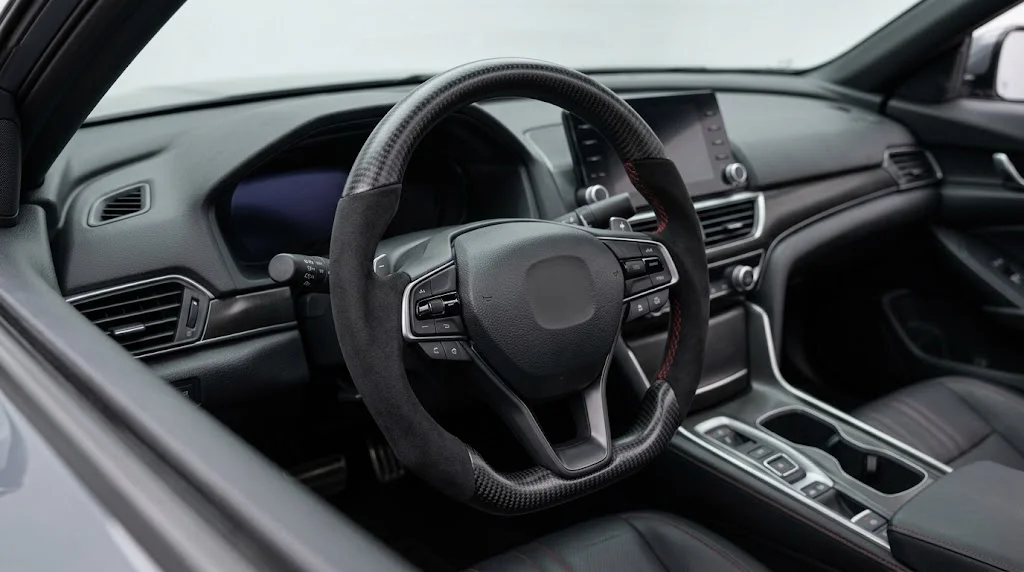
The wheel above carries all three surfaces in a Type R cabin. Each one needs its own cloth.
A damp microfibre cloth does almost all the work on carbon. Work along the weave, then turn the cloth and dry the surface before it airs.
Abrasive polish is the thing to avoid. It turns a matte coat glossy in patches and leaves a gloss coat cloudy along the edges of the weave.
Brush first, and brush dry. A soft brush lifts the fibres and redistributes the oils that make the nap look shiny.
For a mark that remains, use the smallest amount of water on a cloth and blot rather than rub. Soaking the fabric is what mats it down, and a soaked grip takes days to recover.
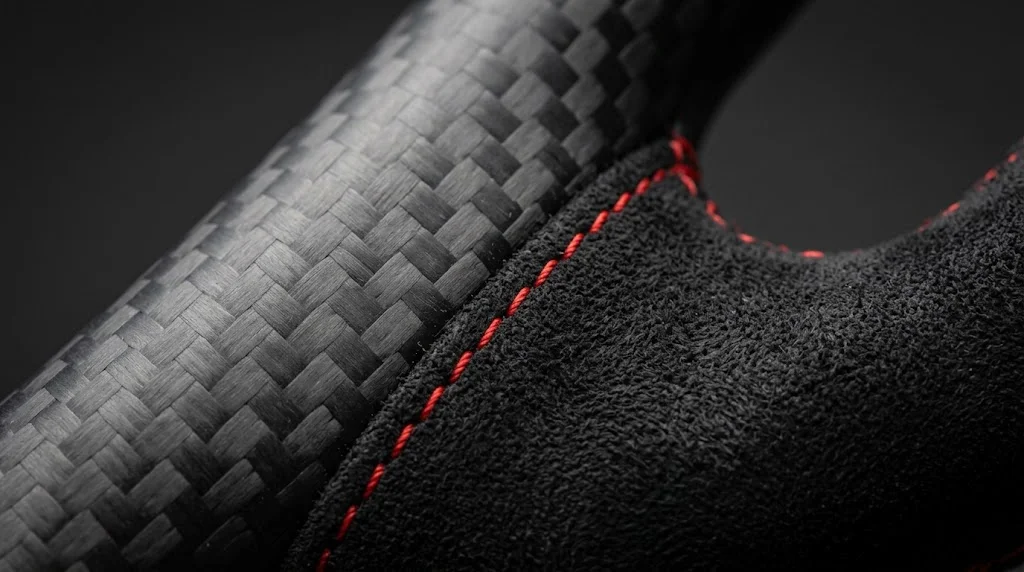
The close-up shows the brush and cloth we recommend. Nothing else is needed for a routine clean.
Shine on leather is oil and skin residue packed into the grain. A damp cloth removes most of it, and a leather balm twice a year keeps the surface supple.
A dry cloth after the damp one stops water sitting in the grain. The second pass takes seconds and leaves the surface even.
If the shine keeps returning within a week, the leather is telling you something about hand contact rather than about dirt. A slightly thicker grip often solves it.
Coffee and soft drinks dry into a sticky film that traps dust. Blot the spill while it is wet, then clean the area again once it has dried.
Sugar left in the nap will feel tacky for days. A second pass with a barely damp cloth, followed by brushing, usually clears it without wetting the fabric through.
The kit is small, and none of it is expensive. The list below covers everything a routine clean needs.
Some products do more harm than the dirt they remove. The list below is what we advise against on any Honda steering wheel.
Switches sit inside a frame that collects dust at the edges. A dry brush reaches those corners without pushing dirt into the gaps.
Keep liquid away from the button pods and from the paddle mounts. A damp cloth is fine on the surrounding surface, and a wet one is not.
Dirt collects along the seam where two materials meet, and stitching holds it there. A soft brush run along the seam lifts most of it without pulling the thread.
A dry brush is enough for routine work. Where the seam has gone pale with salt, a barely damp cloth followed by a dry brush brings the colour back. Leather at the seam takes the same balm as the grips.
Road salt dries into a pale film that shows on dark leather and on the nap. A quick wipe with a damp cloth after a salty drive takes a minute.
Sun does slower damage. A windscreen shade during the summer keeps the upper rim from drying, and the same habit protects the stitching.
Rubber mats and a boot tray help less than a weekly wipe. Salt reaches the rim from your hands rather than from your feet, which is why the grips show it first.
Cleaning is not the only reason owners write to us. Four items help us price a replacement rim if the surface cannot be saved. Send the model, the year and the trim first. Then add a photograph of the wheel face, and one of the rear with the airbag out.
Anyone searching Honda clean alcantara steering wheel is usually dealing with winter grime rather than a spill. Once the fabric has lost its nap across the whole grip, a new cover is often cheaper than repeated cleaning.
Some wear cannot be reversed. Leather that has cracked through the grain, or a nap that stays flat after brushing and drying, will not recover with another product.
A re-trim is the answer at that point, and it also gives you the chance to change the material mix. If the wheel is only dull rather than damaged, cleaning remains the cheaper route.
Cleaning changes nothing in the electronics, so no coding is involved in the routine described here. A rim swap is a different matter.
Where the factory module, the wiring and the vehicle specific parts are reused, further coding may not be needed after a swap. A car that gains a function it never had is the other case, and a workshop visit may then be needed.
Most damage on these rims comes from a cleaning product rather than from fitment. An abrasive polish dulls carbon within a few applications. A soaked grip stays matted for days, and a degreaser can lift the colour out of stitching.
Genuine compatibility problems still appear when a rim is replaced. A wheel from another Honda generation can share the badge and carry a different button frame. That is why the fitment check happens before an order rather than after the parcel arrives.
Once a week for the nap, and once a month for carbon. Daily drivers in dusty areas benefit from a quick dry wipe more often.
Only sparingly, and never as a soak. Water on a cloth is enough for ordinary marks, and blotting beats rubbing.
No, provided the brush is soft and the strokes run one way. A stiff brush pulls fibres and leaves a patchy surface.
Clean the leather, then change how your hands sit at nine and three. A slightly thicker grip also spreads contact.
Light polish on a gloss coat can remove swirls. On a matte coat, polish should stay away entirely.
Yes, and that is the usual way. Keep water away from the button pods and the paddle mounts, and dry the rim before you drive.
Ten to fifteen working days in production, then fifteen to twenty days for shipping. Expect twenty-five to thirty-five days from order to delivery.
Every cover is cut, stitched and assembled in our Guangzhou workshop after an order arrives. Thirteen or more years of design, engineering and precision manufacturing sit behind the patterns we hold. The material is matched to your car before work starts.
Surface, stitch and shape stay your decisions. Orders ship tracked worldwide with a three-year warranty and thirty days for returns via an RMA request. The care questions that come up are answered by the same team.
Two guides answer what owners ask next. The measuring guide covers the figures we need before a build. The installation guide walks through the battery and airbag sequence for a swap.
The full range sits in the shop, and the Honda pages are Honda fitment, the Civic listing and the Civic Type R listing.
Say which car you drive and which surface is giving trouble, then add the year, the trim and a photograph of the wheel face. We will reply with a recommendation, and with a build date if a new cover is the better answer.
The catalogue holds two entries for the cars owners bring to us most often. The first is the bright carbon wheel listed for the Civic and CR-V. The second is the forged carbon wheel for the CR-V and Jade. Either can be specified with a suede or leather grip. That choice decides how much of a Honda carbon fiber steering wheel cleaning routine you will be doing.
For background reading, the installation guide covers the battery and airbag sequence, and the FAQ collects the questions owners raise most. The about page describes the workshop, and fitment or delivery questions can go to the contact page. Lead times are listed in the shipping policy, and returns fall under the return and refund policy. The Magnuson-Moss Warranty Act sets the federal minimum standards, and the Code of Federal Regulations carries the related warranty rules. Care questions can go through the inquiry form.
A modified Honda does not lose its warranty as a whole. Here is how the causation test works, what a dealer can still ask, and how to keep a claim on the record.
Read More →How a heated steering wheel retrofit works on a Honda Civic, CR-V or Accord: what the upgrade adds, fitment checks and how to test the heater afterwards.
Read More →How a flat bottom and a round rim differ on a Honda: which shape suits a Civic Type R, a daily Civic, an Accord or a CR-V, and what changes at the wheel.
Read More →