The Honda Steering Wheel Warranty and Magnuson-Moss Guide
A modified Honda does not lose its warranty as a whole. Here is how the causation test works, what a dealer can still ask, and how to keep a claim on the record.
Read More →Guide · 10/5/2026
What a paddle shifter upgrade changes on a Honda: paddle types, switch travel, wiring, fitment checks and what to test once the new paddles are fitted.
Paddle shifters are the one part of a wheel that drivers touch hardest and think about least. Factory plastic paddles feel vague, look ordinary and flex under a firm pull. Upgrading them changes how a car feels when you ask for a downshift. This guide explains what a Honda paddle shifter upgrade involves, which models it suits, and where the honest limits are.
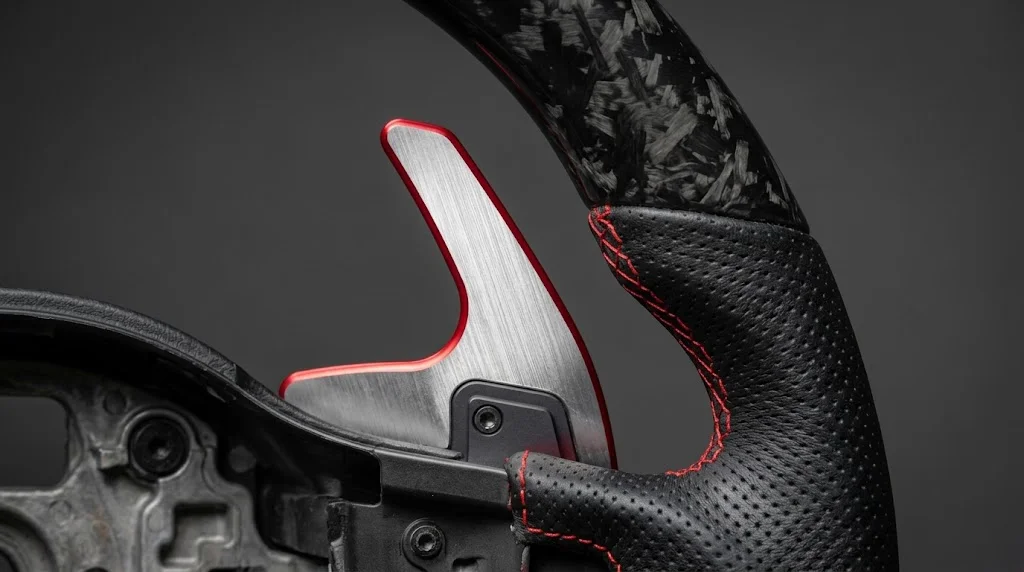
Replacing the paddles improves three things. The material gets stiffer, so the pull feels more direct. The shape gets longer or more curved, so the paddle sits closer to a fingertip. The finish gets better, which matters if the rest of the wheel is being retrimmed at the same time.
| Attribute | Factory paddle | Upgraded paddle |
|---|---|---|
| Material | Moulded plastic | Brushed alloy or forged carbon |
| Feel | Soft, some flex | Rigid, immediate |
| Reach | Short and flat | Longer, often curved or extended |
| Appearance | Functional | Matches carbon or alloy trim |
| Weight | Light | Slightly heavier, still negligible |
These parts belong to cars with an automatic or continuously variable transmission. It covers the Accord with its ten-speed automatic, Civic models with the CVT, and the CR-V. Owners are often surprised by this. A car with a CVT can still have paddles, because the transmission offers a manual mode with stepped ratios. Checking the steering wheel is the quickest way to know. Choosing the right Honda paddle shifter upgrade for your car comes down to the transmission. The Civic Type R is the exception everyone forgets. It left the factory with a manual gearbox, so there is nothing to upgrade on that car.
For a manual Honda, the equivalent work is a new rim without paddle cut-outs. It is a different order, and we will say so rather than sell something that does not apply.
The range splits into three families, and all of them are supplied. Standard alloy paddles replace the factory plastic parts one for one and keep the original reach. Extended paddles add length so the fingertip finds them without leaving the rim. Forged carbon paddles match a carbon wheel and sit between the two on weight.
Weight barely changes between the three, so this is not a decision about performance. It is about how the paddle presents itself to your hand when you are not looking at it. Each type has a personality. Standard alloy suits a daily driver, because nothing changes about how you reach for a gear. Extended paddles suit a car used on a track, where hands stay planted. Forged carbon suits owners who are already changing the wheel finish.
The paddle is a switch on a small loom, and the loom is not usually replaced. The new paddle has to press the existing switch cleanly, which is why fitment between paddle and frame matters more than the material.
Two failure modes appear when that fitment is wrong. A paddle that sits too far from the switch gives a dead first press. A paddle that presses constantly leaves the car in manual mode without warning. Both are avoided by checking the frame before ordering. Ask us for the switch travel measurement if you are comparing parts yourself. It is the single number that predicts whether a paddle will feel crisp.
For most owners, a Honda paddle shifter upgrade is the first change they make to the wheel. Feel is the main reason. A downshift on a good road is more satisfying when the paddle answers immediately rather than flexing first. Owners who use manual mode often describe the factory part as the weakest control in the car.
Appearance is the second reason, and it usually arrives with a wheel change. A carbon rim with plastic paddles looks unfinished, so the paddle upgrade becomes part of the same order.
An upgrade starts with the frame, not the paddle. Provide the chassis number, the transmission type, a photograph of the wheel face, and a photograph of the paddle area from behind. A Honda paddle shifter upgrade is confirmed against those details before anything is made.
Transmission type matters as much as the model name, so state it clearly when you write to us. It changes which parts apply. Those images show us the paddle mount, the switch position and the cut-out shape. Fitment depends on all three, and the transmission type tells us whether paddles exist at all. Should a photograph be unclear, we will ask for another rather than guess.
A paddle change should not disturb anything else on the wheel. The frame carries the buttons, the airbag and the paddle mounts together.
| Function | Typical outcome |
|---|---|
| Airbag | Original module normally reused; cover built to suit it |
| Multifunction buttons | Retained when the original button frame is reused |
| Honda Sensing controls | Depends on the hands-on detection fitted to the original wheel |
| Drive mode buttons | Retained where the original frame carries them |
| Horn | Retained through the original airbag module |
Manual cars have no paddle hardware at all, so nothing is retained or added on those builds.
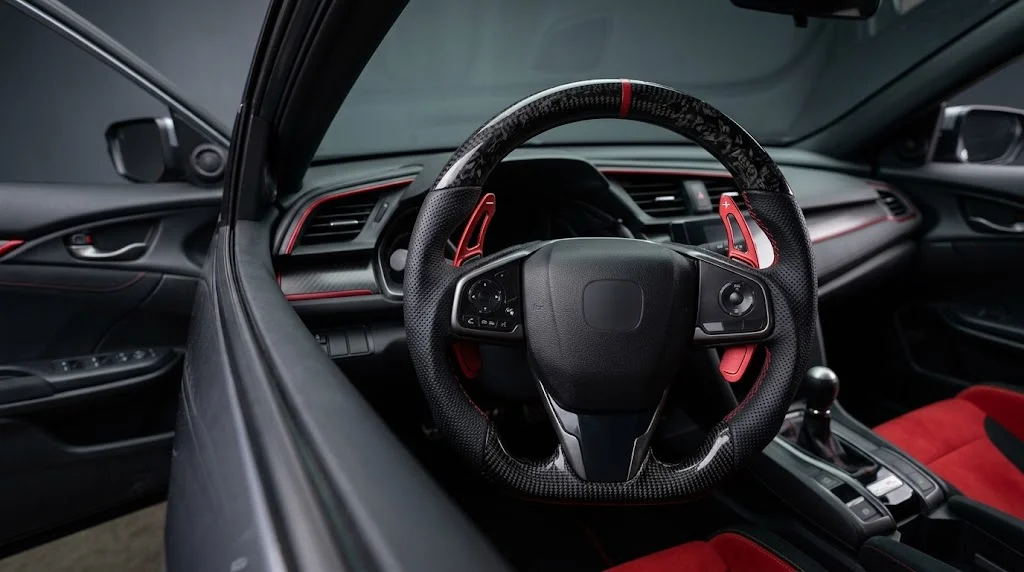
The paddles can be changed on their own, without touching the rim. This suits an owner who is happy with the wheel and only wants a better shift action. The work is short and reversible, and the original paddles can be kept.
Keep the original paddles in the box with the factory wheel. Should the car ever be sold or returned to standard, both go back on in an afternoon. Most owners combine the two jobs instead. A new rim and new paddles arrive together, which saves a second strip-down later. If you are considering both, order them at the same time so the frame is matched once.
Anything on the wheel involves the airbag, so give the work to someone qualified. Disconnect the battery and let the car go to sleep fully before touching the column. Follow Honda procedure for your chassis rather than a general online guide. Allow the car to sit for a few minutes after the battery is disconnected. Airbag systems hold a charge briefly, and patience costs nothing. Lay the module on something soft, and tighten the centre fastener to the figure in the workshop manual. Nothing else should replace that number.
Once it is back together, drive a short distance and confirm the rim is centred. Test each paddle, every button and the horn. A warning lamp that stays on means the car should be scanned before further driving.
Warranty questions follow any change to the wheel. An aftermarket steering wheel does not automatically void a vehicle warranty under U.S. federal warranty law, but warranty coverage can still depend on whether the modification caused the specific failure being claimed.
A paddle swap rarely needs coding, because the paddle is a switch rather than a module. The signal it sends is unchanged, so the transmission control unit sees exactly what it saw before.
Coding becomes relevant when the whole wheel is replaced with one from another generation. In that case the control unit may need to be told what is fitted. Send the chassis number with images of both units and we will say what your car is likely to require.
After a Honda paddle shifter upgrade, work through the checks below before calling the job finished. Four problems account for most of the complaints we hear. A paddle from a different frame sits at the wrong angle and presses the switch unevenly. An extended paddle can foul the column shroud on a car with a thicker rim. A carbon paddle without a return spring feels dead on release. The last one catches people out, because a paddle that looks identical to the factory part may not have the same switch travel. All four are avoidable. A photograph of the mount, the switch and the shroud is usually enough to catch them before anything is manufactured.
No. It was sold with a manual gearbox, so there is nothing to upgrade. Manual owners usually change the rim instead.
Not realistically. The transmission control unit has to support manual mode, and a car built without paddles normally does not.
It will, briefly. In practice the paddle warms within a minute of driving, and most owners stop noticing after the first week.
Not on the frames we supply. We check the clearance against your photograph before making anything.
Yes. We return the factory parts with the finished order, so the change stays reversible.
Ten to fifteen working days in production, then fifteen to twenty days for shipping. Expect twenty-five to thirty-five days overall.
Paddles and rims are cut, stitched and assembled in our own Guangzhou workshop. Thirteen or more years of design and production experience sit behind the catalogue patterns, and nothing starts before an order arrives. Type, material and stitch are your decisions; each one is checked against your frame before the first cut. Every order ships tracked worldwide with a three-year warranty and thirty days for returns via an RMA request.
Our Civic Type R FK8 and FL5 guide covers the manual cars in detail, and explains why they carry no paddles. It is the natural companion to this one. The full range sits in the shop, and the Honda pages are Honda fitment and the Accord listing.
Tell us the model and whether the car is automatic or manual, then add the chassis number and a photograph of the paddle area. We will reply with a confirmed build and a date before we begin your Honda paddle shifter upgrade. Three catalogue entries suit these cars. The first is the gloss carbon wheel for the Civic and CR-V. The second is the carbon fibre wheel for the Accord and Inspiron. The third is the forged carbon wheel for the CR-V and Jade.
Further reading is available if you want it. The installation guide covers the battery and airbag sequence, and the
A modified Honda does not lose its warranty as a whole. Here is how the causation test works, what a dealer can still ask, and how to keep a claim on the record.
Read More →How a heated steering wheel retrofit works on a Honda Civic, CR-V or Accord: what the upgrade adds, fitment checks and how to test the heater afterwards.
Read More →How a flat bottom and a round rim differ on a Honda: which shape suits a Civic Type R, a daily Civic, an Accord or a CR-V, and what changes at the wheel.
Read More →